Local Law 126 Bronx

Bronx Parking Garage Waterproofing and Leak Repair

Most garage damage starts with water getting somewhere it should not. We find where it is coming in, whether that is a failed expansion joint, a cracked wall, or a drain that backs up, and seal it so the concrete and steel behind it stop breaking down.

Expansion Joint Systems

Crack Injection for Active Leaks

Drain & Ponding Fixes
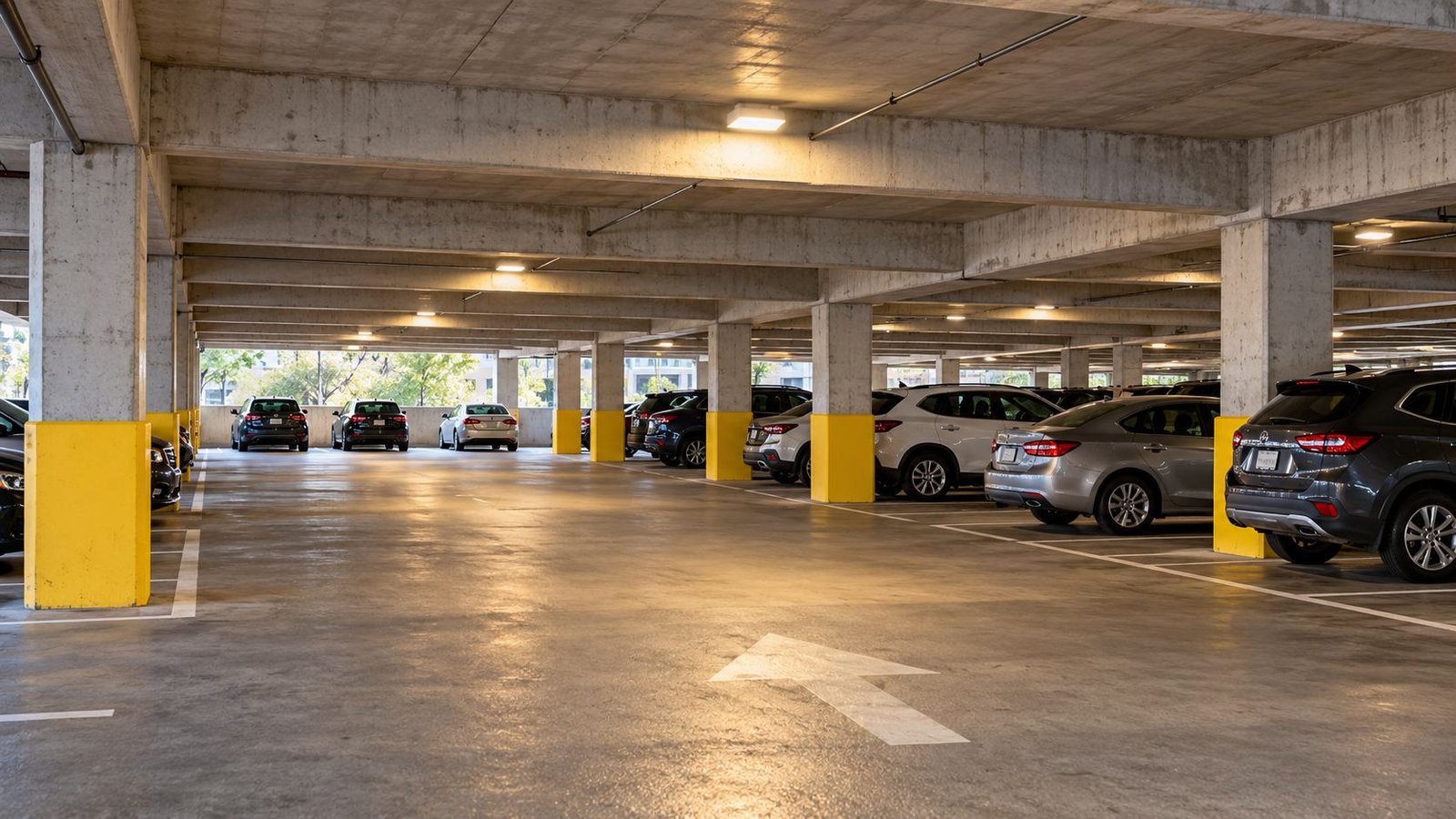
Illustrative concrete parking garage interior with yellow column guards and parked vehicles.

Where Do Parking Garage Leaks Come From?

Water rarely pushes through solid, well-protected concrete. It finds the weak points instead. Expansion joints, worn sealant at control joints and wall edges, cracks that run through the slab, drains that clog or sit too high, and below-grade walls with groundwater behind them are where most garage leaks begin.

Waterproofing a garage means closing each of those paths with the detail that suits it. The open driving surface is protected by a traffic coating, and this page covers everything around and below it, where leaks tend to hide. Under Local Law 126, water moving through the structure gets close attention from your QPSI, because it is what drives rebar corrosion and concrete loss.

Parking Garage Waterproofing Services in The Bronx

Leaks get fixed at the source, whether that source is in the deck, the walls, or the drains.

Expansion & Control Joints

Worn joint seals and failed expansion joint systems cut out and replaced, so the slab can move without letting water through.

Below-Grade Walls & Slabs

Foundation walls and floor slabs that seep groundwater, sealed from the inside without digging up the outside.

Drains, Slopes & Ponding

Clogged, broken, or badly placed drains fixed so water leaves the deck instead of sitting on it.

Signs Your Garage Has a Water Problem

 01

Active Drips at Joints

Water falling from expansion joints onto cars and floors below after rain or snow melt.

 02

White Mineral Streaks

Efflorescence on ceilings and walls, left behind as water carries minerals through the concrete.

 03

Standing Water After Storms

Puddles that stay for hours or days because the deck does not drain to its outlets.

 04

Damp Patches on Walls

Dark, wet areas on below-grade walls that get worse after heavy rain.

 05

Mineral Icicles on Ceilings

Small hanging deposits under cracks where water has been dripping for a long time.

 06

Split or Missing Sealant

Joint sealant that has hardened, cracked, pulled away from the edges, or gone missing in sections.

Why Garage Waterproofing Breaks Down

No waterproofing detail lasts forever. These three things wear it out faster than anything else.

Constant Slab Movement

Garage decks grow and shrink with every temperature swing. Sealants and joints that cannot stretch that far tear loose.

Sun & Freeze-Thaw

Sun hardens sealants on open levels, and water freezing in small gaps pries them wider every winter.

Debris in the Drains

Leaves, grit, and winter sand settle in drain lines until water backs up onto the deck.

How We Stop Garage Leaks in Bronx

Every leak path gets its own fix. Covering everything with one product is how leaks come back.

Expansion Joint Replacement

Failed joints are removed down to sound concrete, the edges are rebuilt where needed, and a new joint system sized for the movement at that joint goes in.

Sealant Joint Renewal

Control joints, coves, and perimeter joints are cut out, cleaned, primed, and resealed with traffic-grade sealant.

Crack Injection

Leaking cracks in slabs and walls are injected with expanding polyurethane resin that stays flexible and stops water even when the crack is wet. Cracks with structural concerns go to an engineer first.

Drain Repair & Additions

Clogged lines are cleared, broken drain bodies replaced, and new drains added where water keeps ponding.

How We Trace a Garage Leak

A drip on one level often starts somewhere else entirely. Finding the real source comes before any repair.

1

Map the Wet Spots

We mark every drip, stain, and damp area level by level, and note when each one shows up.

2

Follow the Water Back

Each wet spot is traced to the joint, crack, wall, or drain above or beside it.

3

Water Test the Suspects

Suspect joints and drains are hose tested or flood tested to confirm the source before we price the work.

4

Repair & Retest

After the repair, the same spot is tested again so you know the leak is actually closed.

Why Your QPSI Cares About Leaks

Water is the starting point for most of the damage a Local Law 126 inspection looks for. Leaking joints, efflorescence, and ponding are often listed in the report, sometimes as SREM items with their own repair dates. Long-running leaks above beams and columns are also a common cause of the rusted steel and loose concrete that get rated more seriously. Stopping the water first protects every concrete repair that comes after it.

1. Joint and drain leaks often listed as SREM

2. Leaks over beams and columns fixed first

3. Before and after water tests on file

From First Leak Call to a Dry Garage

Most waterproofing is done in sections, so the garage stays open while each area is fixed.

1

Scope by Location

You get a scope that lists each joint, crack, wall, and drain by location, with the footage for each.

2

Work in Sections

Small areas are closed one at a time, so most of the parking stays usable while we work.

3

Wet Weather Check

After the next good rain, we walk the levels again to confirm the repaired areas stay dry.

Bronx Conditions That Make Leaks Worse

Two things about Bronx garages come up again and again in leak work.

High Groundwater Near the Water

Garages near the Bronx River, the Harlem River, and Long Island Sound often sit against a high water table, so their below-grade walls are under steady water pressure.

Original Joints Past Their Life

Plenty of older Bronx garages still have the joint seals they were built with, long after those seals stopped doing their job.

Got a Leak You Cannot Track Down?

Send us your report or a few photos of the wet areas, and we will tell you where to look first.

Upload Your Report

What Shapes the Cost of Garage Waterproofing in The Bronx

Waterproofing is priced by the detail, not by the garage. These six factors set the number.

+1 (917) 355-8556

Linear Feet of Joints

Expansion and sealant joints are priced by the foot, so the length to replace drives much of the cost.

Joint System Type

Simple compression seals cost less than heavy preformed systems built for wide movement.

Number of Leaking Cracks

Injection is priced by the crack or by the foot, depending on how deep and wide each one is.

Drain Work

Clearing a line costs far less than cutting in a new drain and running new pipe.

Below-Grade Access

Walls blocked by storage rooms, equipment, or parked cars take longer to reach and prepare.

Level Closures

Closing a level fully for a few days costs less than working around live traffic in small pieces.

Recent Garage Leak Repairs in the Bronx

Illustrative garage inspector wearing a white hard hat and high visibility vest.

Project details pending

Real project title and details will be added here.

Illustrative garage inspector wearing a white hard hat and high visibility vest.

Project details pending

Real project title and details will be added here.

Illustrative garage inspector wearing a white hard hat and high visibility vest.

Project details pending

Real project title and details will be added here.

Illustrative garage inspector wearing a white hard hat and high visibility vest.

Project details pending

Real project title and details will be added here.

Why Bronx Property Owners Call Us for Garage Leaks

We do not call a leak fixed until it has been tested and stayed dry.

Leaks traced to the source before pricing

Water tests before and after each repair

Joint systems sized for real movement

Clear scope by joint, crack, and drain

What Bronx Owners Say About Our Leak Repairs

Verified customer review pending. Add approved review text and attribution here.

Review placeholder 01 Draft content — verified review pending

Approved customer feedback will be added here after owner review.

Review placeholder 02 Draft content — verified review pending

This draft card is reserved for a real, verified customer testimonial.

Review placeholder 03 Draft content — verified review pending

Add another genuine customer review and approved attribution before publishing.

Review placeholder 04 Draft content — verified review pending

Garage Waterproofing Across Bronx Neighborhoods

From waterfront co-ops to buildings with deep below-grade levels, we stop garage leaks all over the borough.

Garage Waterproofing and Leak FAQs

What is the best way to stop a leaking expansion joint?

Replace the joint instead of smearing new sealant over the old one. The failed joint is cut out to sound concrete, the edges are rebuilt where they have broken down, and a new joint system sized for the movement at that joint is installed. Patching over an old seal usually leaks again within a season.

How long do garage joint sealants last?

Traffic-grade sealants usually hold up for several years before they harden and split. They fail sooner on sunny roof levels and in busy drive lanes. Looking them over every spring catches the failures before water reaches the steel.

Can a below-grade wall leak be fixed from inside the garage?

Yes. Most garage walls below grade cannot be dug out from the outside, so leaks are stopped from inside with polyurethane injection at cracks and tie holes, and with cement-based waterproof coatings on damp areas. This controls the water without any excavation.

What is the white crust on my garage ceiling?

That is efflorescence, minerals that water carries through the concrete and leaves behind when it dries. It means water is moving through the slab, so the source above should be found and sealed. Rust stains mixed in with it can mean the steel is already being affected.

Is crack injection a permanent fix?

For leaking cracks that move very little, polyurethane injection is a long-lasting fix. Cracks that keep opening and closing may need to be turned into a sealed joint instead, and cracks with structural concerns are reviewed by an engineer before anything is injected.

Why does water pond on my garage deck?

Usually because drains are clogged, set too high, or spaced too far apart, or because the slab has settled and lost its slope. Clearing or adding drains fixes most cases, and low spots can be built up so water runs to the outlets.

Do leaks have to be fixed for Local Law 126?

If your QPSI lists a leak, or the damage it is causing, it has to be dealt with within the timeframe given in the report. Even when a leak is not listed, fixing it early keeps it from turning into a concrete or steel problem by the next inspection.

Can waterproofing work be done in winter?

Injection and other interior below-grade work can go ahead all year. Sealants and joint systems on open levels need dry surfaces and warm enough temperatures, so that work is usually scheduled between spring and fall.

Related Local Law 126 Services

Scroll to Top